Why every recipe figure is an estimate
Working out nutrition from ingredients is a standard method. European labeling rules allow it, and food scientists have tested it against the lab for decades. Those tests show its limits:
- Food varies. Two carrots, two seasons, or two brands aren’t the same. A database gives an expected value, not the value of the food in your kitchen. The UN’s handbook on food composition data calls a database “at best, an approximate quantitative guide” for some nutrients.
- A single dish can be well off. In a Danish study of 155 fast-food samples, calculated values for each food were either within 15% of the lab result or more than 50% away. The biggest average gap was for saturated fat.
- When nutrition tools disagree, the main reason is the food data underneath. That’s why we show the food behind every ingredient.
- Labels are estimates too. Packaged-food labels are allowed some leeway, and European guidance on label tolerances names values “calculated by recipe instead of analysis” as one reason they vary.
No method removes these limits, including ours. What we can do is show you how each figure was made, so you can decide how far to rely on it.
Where the data comes from
We use USDA FoodData Central and, where USDA has no data, product labels. Branded products and barcodes are looked up in USDA’s branded food records and in Open Food Facts, a community-maintained database. Every ingredient in the panel names its source.
- USDA FoodData CentralFirst choice for every ingredient
- Product labelsWhere USDA has no data
- Branded and barcodesUSDA branded records and Open Food Facts
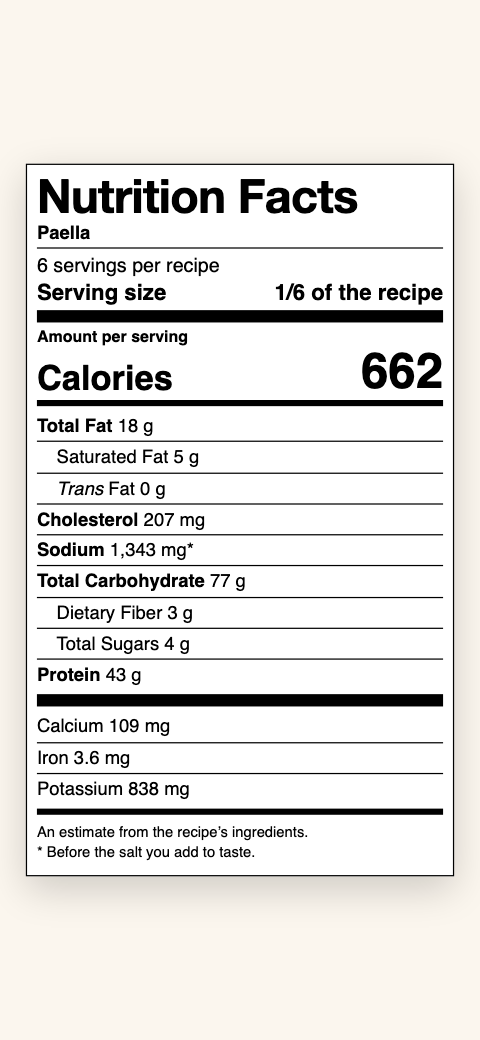
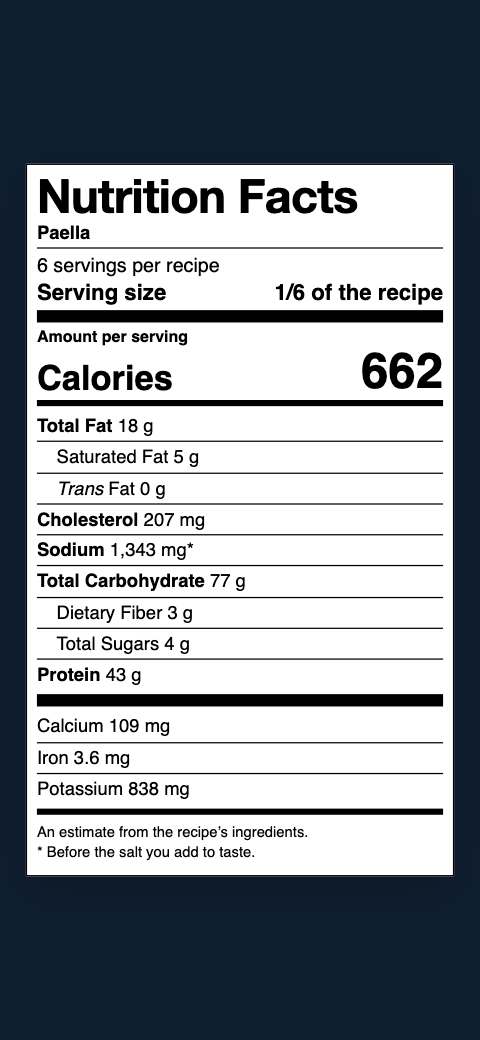
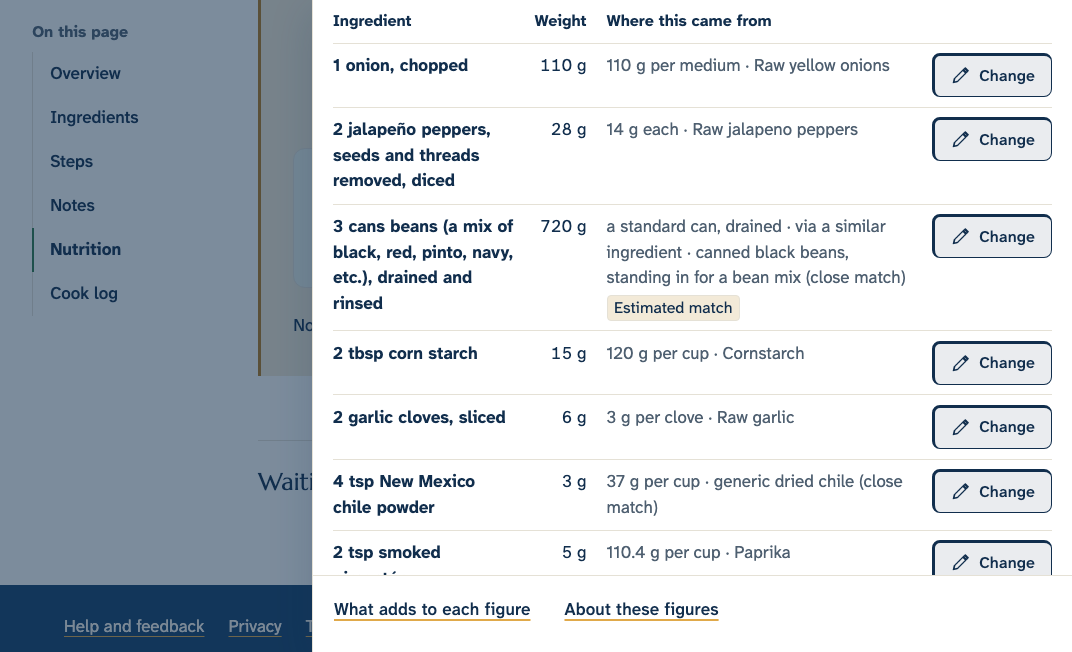
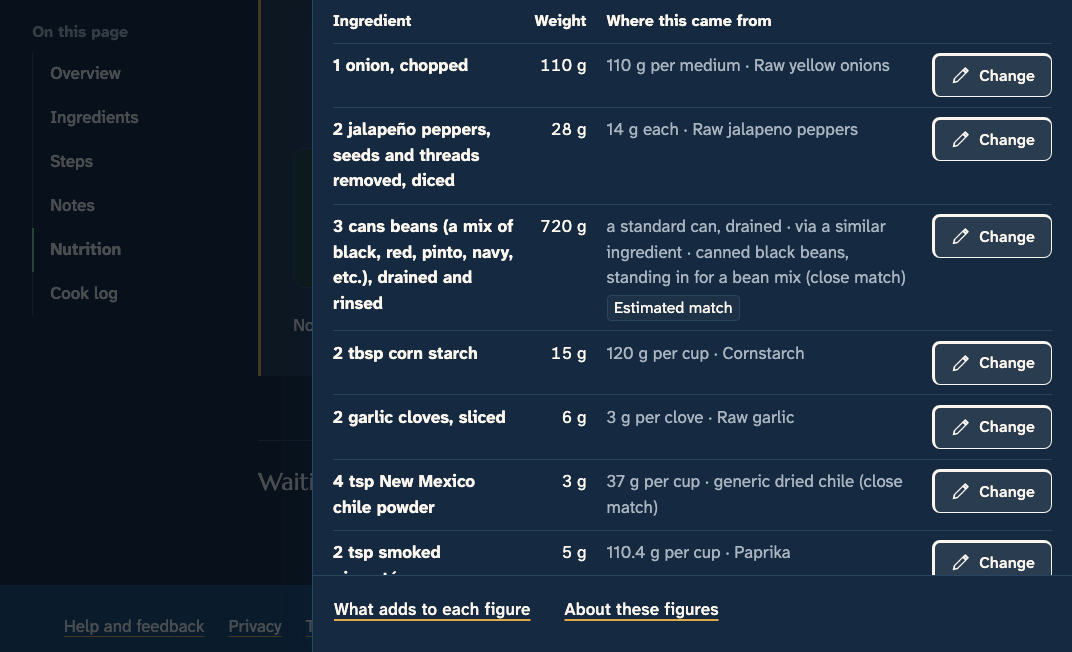
From ingredient line to figure
- 1 · Read2 · cup · onion
- 2 · MatchOnions, rawUSDA FoodData Central
- 3 · Weighabout 320 gfrom the weight of a cup of chopped onion
- 4 · Add up+ every other line÷ servings
- Read the line. Each line, such as “2 cups chopped onion,” is read into an amount, a unit, and a food.
- Match the food. The food is matched to a nutrition record. Matches no one at Capseta has checked are marked “Estimated match.”
- Weigh it. The amount is turned into grams. Cups and spoons use the weight of that ingredient, so a cup of flour and a cup of honey weigh different amounts. Items like “1 onion” use a typical weight, and the figure becomes a range. Because converting cups and spoons to grams depends on an assumed weight for each ingredient, a recipe that gives weights gets a narrower estimate.
- Add it up. The lines are added together and divided by the servings.
Once a recipe’s matches are saved, the same recipe shows the same figures every time, until you or we change a match.
What we assume when a recipe doesn’t say
Recipes leave things out. When we fill a gap, the panel says what we assumed, and you can replace it.
- Salt “to taste.”
- We count salt as 0.3% of the dish’s known weight. Finishing salt counts as a pinch per plate. If we can’t weigh the dish, we assume a quarter teaspoon for the whole recipe.
- Salt by the spoon.
- A teaspoon of salt can weigh anywhere from about 2.8 g to 6 g, depending on the brand and the shape of its crystals. When a recipe says “salt” or “kosher salt,” we weigh it as Diamond Crystal kosher salt, about 2.8 g a teaspoon. Table, fine, iodized, and sea salt are weighed as table salt, about 6 g a teaspoon.
- “Or.”
- When a recipe offers a choice, such as “vegetable or chicken broth,” we count the one it names first.
- A range of amounts.
- For “3 to 4 cups,” we take the middle.
- Deep frying.
- The frying oil isn’t counted, but the oil the food soaks up is, at about a tenth of the food’s weight.
- Coatings.
- Most of a dredging coating stays in the bowl, so we count about half.
- Alcohol.
- The calories count only the alcohol that survives cooking, based on how long the dish cooks.
- Served alongside.
- Something served on the side with no amount isn’t counted.
Same spoon, twice the sodium: the crystals pack differently. Plain “salt” and “kosher salt” in a recipe are counted as Diamond Crystal. Figures from the brands’ labels, via CSPI.
Changing what we assumed
Every assumption above can be replaced with what you actually do:
- Salt to taste: tell us how much salt you add at the end, per serving. Or give an amount in the recipe, and we use yours.
- Kosher salt: choose Diamond Crystal or Morton’s once, and it’s used in all your recipes.
- “Or”: choose the one you used, and the figures change for that recipe.
- Coatings: tell us how much ends up in the food.
- Weights: give a weight in the recipe, and we use it instead of our estimate.
- Served alongside: add it to the ingredients with an amount to include it.
- Servings: change the servings in the nutrition panel to match your portion.
Your answers change only your own figures.
How much of the dish we could count
The coverage bar shows how much of the dish, by weight, has nutrition data. Anything not counted makes the figures run low, so the panel names those ingredients. If we have figures for less than half of the dish, the panel says so.
What a range means
When part of a dish is weighed by estimate, the figure is a range from the lightest to the heaviest of those estimates. The real figure could be anywhere in it. We also show our single best estimate. To narrow the range, give the weight in the recipe or name the product.
Where it falls short
- Allergens. The method matches foods to nutrition records. It can’t tell you what’s in the product you bought or what it was made alongside, so it isn’t an allergen check. Allergens
- Total sugars only, not added sugars.
- No adjustment for cooking. We don’t adjust for water or vitamins lost in cooking. The one exception is alcohol.
- Phosphorus and potassium may read low for processed ingredients, because food makers often don’t report what they add.
- No % Daily Value and no daily totals.
- Figures are per recipe and per serving. They depend on the recipe’s servings being right.
- USDA data describes American foods. Foods and brands from other countries may match less well.
- An “Estimated match” may be wrong. Check it if a figure surprises you.
How we test it
To come, once our reference benchmark has run.
When something looks wrong
Use “Tell us what looks wrong” in the panel. A person reads every report, and when we had it wrong, the fix reaches everyone.
What happens to your ingredients
Your name never goes with your ingredients. What we send to our AI partners, USDA, or Open Food Facts carries no name, email, or account. Our AI partners don’t train on it and delete it within 30 days. Our Privacy Policy names each one.
How they’re read
- When you add, import, or edit a recipe, its ingredient lines are sent to our AI partners to be read into amounts and foods, the same way an import is.
- A photo of a nutrition label is read the same way, after its location data is removed.
- The figures are estimates, worked out on our own server from a copy of USDA’s data.
- If you search for a branded product, our server sends your search words to USDA.
- A barcode you scan or type is looked up by our server with USDA, then Open Food Facts.
What stays private
- Lines and photos go without your name or account, and aren’t used to train AI models.
- So no line is read twice, we keep a shared copy of how a line like “2 cups flour” reads, with nothing linking it to you or your recipe.
- New food names join a shared food list, and the AI helps match them to USDA records.
- Nothing is sold.
What our team sees
- Matches the AI isn’t sure of, with a few example lines and recipe titles, never whose they are.
- The reports you send, and how many people gave each answer, not who.
Your answers
- Your answers and corrections, including figures from a label, change only your own figures.
- If you choose to share label figures, a person at Capseta checks them first. Then other cooks can pick that product, and your name isn’t attached.
How long it’s kept
- Our AI partners delete ingredient lines and photos within 30 days, unless they’re flagged for a safety review. We don’t keep label photos.
- Your answers, corrections, and reports are deleted with your account. Shared label figures stay available to other cooks.
Sources: USDA FoodData Central, and product labels where USDA has no data.